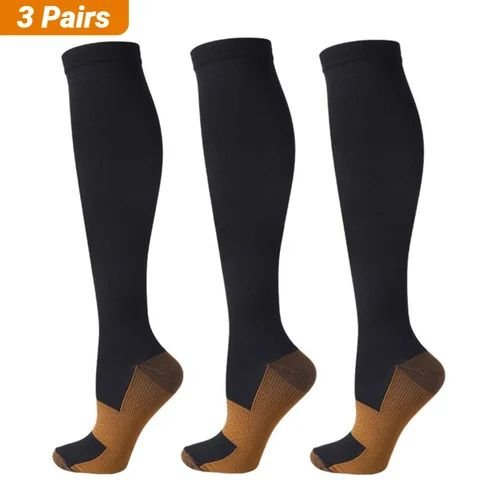
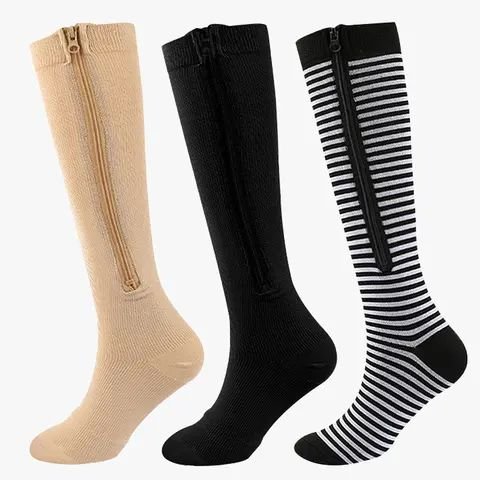
Quick answer: A regular sock is knitted at roughly even tension throughout. A compression sock is knitted firmest at the ankle and progressively looser up the calf. That graduation is the entire difference, and it is why fit and length matter far more than they do with ordinary socks.
People assume the difference is the fabric or the thickness. It is neither - it is the knitting machine.
The actual difference
An ordinary sock is knitted at more or less the same tension from toe to top. It is designed to stay on your foot and be comfortable, and that is the whole brief.
A compression sock is knitted deliberately unevenly: firmest at the ankle, easing progressively as it goes up the calf. That is what "graduated" means, and it is the entire design. Everything else - the fibre, the pattern, the toe seam - is the same set of choices any sock maker faces.
Why that changes how you buy
Because a graduated knit only does what it is designed to do on a leg it fits. An ordinary sock is forgiving: one size covers several shoe sizes and nobody notices. A compression sock is not, because the whole point is where the firm bit sits relative to your ankle and calf.
That is why every guide here starts with measuring, and why calf width is the number people most often get wrong - the sizing and fit guide covers it, and the sizing guide goes further.
Length matters in a way it does not with ordinary socks
With normal socks, ankle versus crew is a look. With these it is functional: an ankle-length compression sock has almost no calf to graduate across, so it behaves quite differently from a knee-high.
Knee-high is the standard for a reason - it covers the calf, which is the part that notices a long day - the knee-high range compares the options, and the knee-high range is where most people start.
How they feel different to wear
Snugger, obviously, and most noticeably around the ankle. The first pair usually feels odd for ten minutes and unremarkable after an hour. A few practical differences from ordinary socks:
- Harder to put on, especially at first - the easy-on range.
- Less forgiving of the wrong size, in both directions.
- More affected by heat in the wash, because there is far more elastane to ruin.
- Worn for a purpose rather than all day every day by default.
When an ordinary sock is the better choice
Honestly, quite often. Around the house on a day you are barely upright. In bed, unless you have a reason - the FAQs guide covers that. Under a shoe that is already tight, where an extra snug layer will just annoy you. And any time a pair does not fit properly, where an ordinary sock is genuinely more comfortable than a bad compression one.
These are not a replacement for your sock drawer. They are for the days that ask more of your legs - a flight, a shift, a long walk, a busy stretch on your feet.
Can you tell by looking?
Increasingly not, which is the point. The old assumption that these look clinical stopped being true a while ago - plenty of ours are patterned and read as ordinary socks - the patterned four-pack and Midnight Patterns are examples, and the everyday range covers the wider point.
Can you wear them together?
Yes, and one combination is genuinely useful.
A footless calf sleeve goes over your own ordinary socks, which means you get the calf part without changing what is on your feet. That suits the gym, a warm day, or anyone who has a favourite pair of work socks they are not giving up - the footless range covers those.
What does not work is wearing a compression sock over another sock, which bunches and changes the fit.
Thickness is a separate question
Worth separating, because people conflate the two.
A compression sock is not necessarily thicker than an ordinary one - some are noticeably thin. Thickness is about warmth and cushioning; the graduated knit is about how the tension is distributed. You can have a thin firm sock and a thick soft one.
If you are fitting them inside a snug shoe, look at the thickness rather than the specification - it is the thing that decides whether the shoe still fits.
Care is different too
An ordinary sock survives most things. These do not: heat destroys the elastane and a pair that has been tumble-dried never grips the same way again. Cool wash, inside out, dry flat - the care and FAQs guide covers it, and the full range covers when a pair is done.
Are they worth owning?
If you fly, work long shifts on your feet, run, or are pregnant, most people who try a well-fitting pair keep wearing them. If you are mostly sitting at home, probably not - the complete buyer's guide goes into that, and the buyer's guide covers choosing.
This is comfort advice, not medical advice. Browse the bestsellers or everyday comfort.
The short version
- The difference is the knit: even tension versus firmest at the ankle, easing upward.
- Graduation only works on a leg the sock fits, so sizing is far less forgiving.
- Length is functional here, not cosmetic - an ankle sock has nothing to graduate across.
- They are for demanding days, not a replacement for your whole sock drawer.
- Heat in the wash ruins them in a way it never ruins an ordinary sock.
Frequently asked questions
What is the actual difference from a normal sock?
How it is knitted. An ordinary sock is knitted at roughly even tension throughout; a compression sock is knitted firmest at the ankle and progressively looser up the calf. That graduation is the entire difference.
Why does sizing matter so much more?
Because a graduated knit only works where the firm part sits correctly relative to your ankle and calf. Ordinary socks are forgiving across several shoe sizes; these are not, in either direction.
Should I wear them instead of normal socks?
No - they are for days that ask more of your legs, such as a flight, a long shift or a big walk. Around the house on a quiet day, or under an already-tight shoe, an ordinary sock is the better choice.
Do they look different?
Increasingly not. Patterned and plain everyday designs do the same job and read as ordinary socks, which is largely why people keep wearing them rather than leaving them in a drawer.
Is the care different?
Yes, and it matters more. There is far more elastane in a compression sock, and heat destroys it - a tumble-dried pair never grips the same way again. Wash cool, inside out, and dry flat.